

Blockchain & Digital Assets Weekly Briefing - Week 35
Updated: Sep 20, 2025
Week ending 29th August 2025

Welcome to our Weekly Briefing. We cover Lutnick’s push to measure GDP on-chain, Tether bringing USDT natively to Bitcoin via RGB, and Aave’s Horizon initiative lending stablecoins to institutions with tokenized RWAs. Plus, Bitwise eyes the first U.S. spot LINK ETF, and the CFTC signals offshore crypto platforms may soon open to U.S. traders.
Measuring the economy, block by block — Lutnick’s plan to put GDP on the blockchain.
USDT comes home: Tether brings stablecoins native to Bitcoin with RGB.
Horizon by Aave: lending stablecoins to institutions via tokenized real-world assets.
Bitwise bets on Chainlink: first U.S. spot LINK ETF on the horizon.
CFTC clears the way: offshore crypto platforms could welcome U.S. traders again.
Measuring the economy, block by block — Lutnick’s plan to put GDP on the blockchain
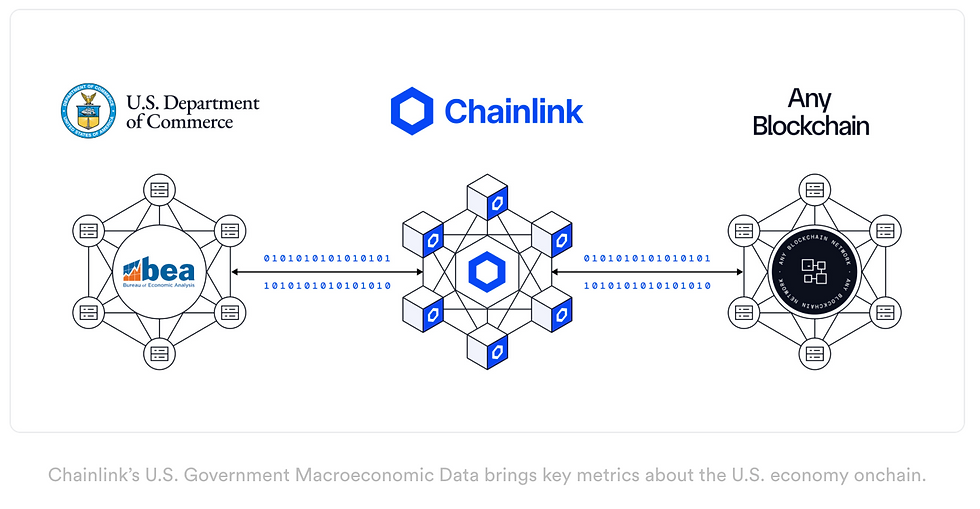
At the August 26, 2025 White House cabinet meeting, Commerce Secretary Howard Lutnick announced that the Department of Commerce has begun publishing the Q2 U.S. Gross Domestic Product (GDP) onto 5 Public Blockchains: Bitcoin, Ethereum, Solana, TRON, Stellar and 4 Layer-2 and Scaling Solutions: Avalanche, Arbitrum One, Polygon PoS, Optimism. The initiative, described as part of President Trump’s “crypto president” agenda, aims to modernize how economic data is distributed and accessed across government.
In addition to moving GDP data on-chain, Lutnick suggested he plans to change how GDP itself is calculated—specifically by reducing or removing the impact of government spending in the measure. The GDP figure is produced by the Bureau of Economic Analysis (BEA), which operates within the Commerce Department.
[ How GDP is Calculated Today
The U.S. (via the Bureau of Economic Analysis, or BEA) uses the expenditure approach to calculate GDP: GDP=C+I+G+(X−M)
Where:
C = Consumption (household spending)
I = Investment (business spending, housing, inventories)
G = Government spending (federal, state, local)
X – M = Exports minus imports (net trade)
--> The Case For Adjusting GDP
Debt distortion: If government borrows heavily, GDP can rise even if private consumption/investment is weak.
Productivity signal: Some argue that excluding government spending gives a “truer” picture of market-driven economic activity.
Political optics: It may be used to highlight “real” growth outside government stimulus. ]
Industry Partners in the Effort
The Commerce Department is not acting alone. Officials confirmed that crypto exchanges Coinbase, Kraken, and Gemini are part of the rollout. The department reportedly used these platforms to purchase cryptocurrency needed to pay transaction fees—commonly called “gas”—in order to record data on blockchains. To ensure reliable delivery of off-chain GDP data onto the chains, the department employed Chainlink and Pyth oracles. Both Kraken and Gemini are preparing for public listings in the coming months, a sign that the project coincides with a broader moment for crypto’s integration into mainstream markets.
Why It Matters
Transparency & integrity: Blockchain’s immutability could make economic data more verifiable and protect against tampering.
Global alignment: Governments worldwide are already experimenting with blockchain in public administration. Estonia uses it for e-Health records, Georgia pioneered its land registry on blockchain, the EU is developing the European Blockchain Services Infrastructure, Singapore has trialed cross-border trade systems, and California’s DMV is digitizing vehicle titles.
Skeptical context: Critics argue that simply reposting the same data onchain does little to solve underlying trust issues, since the methodology and collection process remain unchanged. Lutnick’s proposal to alter how GDP is reported may add another layer of controversy, raising questions about both accuracy and political framing.
Key Questions & Considerations
What problem does blockchain solve? Traditional databases already distribute economic data efficiently. While blockchain adds immutability and decentralization, those advantages may be limited in a centrally managed government system.
Technical clarity: Officials have not confirmed how privacy will be managed, or how data formats will be standardized. It's important to note that while the hashes of the GDP data are now available on these blockchains, the full datasets themselves are not directly published on-chain. Instead, these hashes serve as cryptographic proofs of the data's integrity and authenticity. The actual GDP figures and related economic data remain accessible through traditional channels, such as the Bureau of Economic Analysis (BEA) website.
Market angle: The inclusion of major exchanges like Coinbase, Kraken, and Gemini underscores how public-private partnerships could shape this initiative—especially with Kraken and Gemini eyeing IPOs.
USDT comes home: Tether brings stablecoins native to Bitcoin with RGB
In a move that could reshape stablecoin use, Tether has announced plans to issue its flagship stablecoin, USDT, directly on Bitcoin’s network using the RGB protocol.
RGB is a newly matured protocol (v0.11.1) that anchors asset proofs to Bitcoin while keeping details off-chain, enabling scalable and private asset transfers. This architecture avoids blockchain bloat and leverages Bitcoin’s security while making new kinds of transactions possible.
Importantly, Tether is also working with the Lightning Network to ensure USDT can flow through the same high-speed payment channels already used for Bitcoin. This creates a powerful combo: stablecoins with the speed of Lightning and the security of Bitcoin.
Paolo Ardoino, Tether’s CEO, highlighted the aim:
“Bitcoin deserves a stablecoin that feels truly native, lightweight, private, and scalable.”
Why It Matters: The Key Benefits
a. Native Stability on Bitcoin
USDT will live directly on Bitcoin—not as a wrapped token or on a sidechain. This gives it Bitcoin-level robustness with fewer dependencies.
b. Privacy & Scalability
RGB ensures that balances and transfers remain private, validated client-side, and don’t congest the Bitcoin blockchain.
c. Lightning Network Integration
USDT transactions can move through Lightning channels, unlocking instant, low-fee global payments and cross-border transfers.
d. Offline Possibilities
Even without continuous internet, users can transact in USDT, syncing later once connectivity is restored.
e. Simplified Wallets
People can hold BTC and USDT together in a single wallet and use either seamlessly.
Real-World Snapshot
Cross-Border Remittances with Lightning + RGB
Maria lives in a rural area with limited banking options. Her brother in the U.S. wants to send her $50 in USDT. He uses an RGB-enabled Lightning wallet to send the payment:
The transfer moves instantly over the Lightning Network, avoiding high fees and delays of traditional remittance services.
Because the transaction details are validated client-side, Maria’s wallet checks and confirms the integrity of the payment without relying on every node on the Bitcoin network.
The transfer remains private: balances and asset details don’t appear on the Bitcoin blockchain, only the minimal proof of commitment.
Even if Maria goes offline for a while, the payment can be finalized once she reconnects—ensuring usability even in low-connectivity regions.
In the same wallet, she can hold both BTC and USDT and choose which asset to spend, depending on the situation.
For Maria, the experience feels like a fast, private, and secure digital cash transfer—anchored by Bitcoin but enhanced with Lightning speed and RGB’s privacy.
Tether’s move combines the stability of USDT with the power of Bitcoin and the Lightning Network. For users, it promises faster and cheaper cross-border payments, private transactions, and simpler wallets.
Horizon by Aave: lending stablecoins to institutions via tokenized real-world assets
Aave Labs has officially launched Horizon, a new lending market on Ethereum designed to enable qualified institutions to borrow stablecoins against tokenized real-world assets (RWAs). This move aims to integrate traditional financial assets into decentralized finance (DeFi), enhancing liquidity and capital efficiency.
What is Horizon?
Horizon operates as a permissioned instance of the Aave Protocol V3.3, tailored to meet regulatory requirements for RWAs. It allows institutions to use tokenized assets as collateral for borrowing stablecoins, without the need to sell or redeem these assets. This approach transforms RWAs into productive components within the DeFi ecosystem.
Key Features:
Collateral & Yield: Horizon supports yield-bearing stablecoins from partners like Circle, Superstate, and Centrifuge, offering investors returns through diversified portfolios of short-duration U.S. Treasury bills, crypto strategies, and tokenized collateral (those stablecoins are only tradable for non-U.S. persons).
Stablecoin Lending: Users can supply stablecoins like USDC, GHO, and RLUSD to earn yield from institutional borrowers.
Smart Contract Automation: All borrowing and lending activities are executed automatically through smart contracts, ensuring efficiency and transparency.
Risk Management: The platform incorporates Chainlink's NAVLink for real-time net asset value reporting and Llama Risk for comprehensive risk analysis.
Strategic Partnerships:
Horizon has partnered with leading institutions across tokenized assets and stablecoins, including Circle, Superstate, Centrifuge, Chainlink, Ethena, KAIO, OpenEden, Ripple, Securitize, VanEck, and WisdomTree. These collaborations aim to expand access to a $26 billion RWA market, facilitating the growth of institutional DeFi.
Market Impact:
By enabling RWAs to serve as collateral within DeFi, Horizon addresses the underutilization and capital inefficiency of tokenized assets. This development not only enhances liquidity but also provides stablecoin lenders with new on-chain yield opportunities from a diversified risk profile.
Bitwise bets on Chainlink: first U.S. spot LINK ETF on the horizon
Bitwise Asset Management has taken a significant step in the cryptocurrency investment landscape by filing for the first-ever U.S. spot Chainlink (LINK) exchange-traded fund (ETF). This move positions Bitwise at the forefront of altcoin-focused investment products, following the success of Bitcoin and Ethereum ETFs.
Bitwise Leads with Chainlink ETF Filing
On August 26, 2025, Bitwise submitted a Form S-1 registration statement to the U.S. Securities and Exchange Commission (SEC) for the Bitwise Chainlink ETF. This ETF aims to provide investors with direct exposure to Chainlink's LINK token, marking a pioneering effort in the U.S. market. The fund plans to hold LINK tokens in custody with Coinbase Custody and establish its net asset value based on the CME CF Chainlink–Dollar Reference Rate, calculated by CF Benchmarks Ltd.
Net Asset Value (NAV): This is the “price” of a single share of the ETF. It represents the total value of all the assets the ETF holds (in this case, LINK tokens) divided by the number of ETF shares outstanding.
CME CF Chainlink–Dollar Reference Rate:Instead of using just the market price from one exchange, the ETF uses a standardized benchmark price for Chainlink (LINK) in USD. This rate is produced by the CME CF Reference Rates, which aggregates prices from multiple major exchanges to provide a reliable and tamper-resistant reference.
Calculated by CF Benchmarks Ltd.:CF Benchmarks is an independent financial data company. They calculate and publish the reference rate according to transparent rules. This ensures that the NAV is based on a fair and standardized price rather than fluctuating exchange prices that can vary across markets.
While the filing has not disclosed specifics such as the ticker symbol, listing exchange, or fee structure, the submission initiates the SEC's review process. To proceed, Bitwise must file a Form 19b-4, which will trigger the SEC's approval process for the ETF.
Market Reaction and Institutional Interest
The announcement has had an immediate impact on the market. Chainlink's price surged over 4% to $24.18 within 24 hours of the filing, reflecting investor optimism. This uptick is part of a broader trend, with LINK gaining more than 26% over the past 30 days, though it remains below its peak of nearly $53 in May 2021.
Bitwise's move underscores a growing institutional interest in altcoins. The firm has previously launched successful ETFs tracking Bitcoin and Ethereum, with assets under management of $2.26 billion and $460 million, respectively. This filing signals a strategic expansion into altcoin-focused investment products.
Implications for the Crypto Investment Landscape
The Bitwise Chainlink ETF filing is a notable development in the evolution of cryptocurrency investment vehicles. By seeking to offer a regulated, transparent, and secure method for investors to gain exposure to Chainlink, Bitwise is setting a precedent for future altcoin ETFs. This move could pave the way for other asset managers to introduce similar products, thereby broadening the scope of institutional and retail investment options in the crypto space.
CFTC clears the way: offshore crypto platforms could welcome U.S. traders again
On August 28, 2025, the U.S. Commodity Futures Trading Commission (CFTC) issued an advisory that could have far-reaching implications for American crypto users and offshore exchanges alike.
Key Points:
Foreign Boards of Trade (FBOT): The advisory clarifies that non-U.S. crypto exchanges can legally serve U.S. traders—particularly for derivatives—if they register as FBOTs and operate within regulatory regimes deemed equivalent to U.S. oversight.
Potential Re-entry for Offshore Players: Platforms such as Binance, previously inaccessible to Americans, may now have a clearer path back into the U.S. market.
Regulatory Clarity Restored: U.S. companies that relocated abroad to continue operations may now find it viable to return and serve U.S. customers under a well-defined framework.
Broader Crypto Policy Push: This move is part of the CFTC's broader "crypto sprint," aiming to bring clarity to digital asset regulation and reinforce U.S. leadership in global markets.
Who Wins (and What Needs Watching)
Stakeholder | Potential Impact |
U.S. Traders | Gain access to offshore liquidity pools and diverse instruments, including derivatives. |
Offshore Exchanges | Can re-enter the U.S. market legally—if they register under the FBOT framework. |
Domestic Platforms | Face increased competition, especially in liquidity-heavy derivatives markets. |
Regulators & Lawmakers | Have a structured path forward to balance oversight and innovation. |
Caution Nuance to Note: FBOT registration is not a simple formality—it involves demonstrating that the foreign platform’s oversight is as rigorous as U.S. rules. The devil is in the details—operational compliance, surveillance, transparency, and enforcement frameworks will all be under scrutiny.
Why It Matters for the Digital Assets Community
This advisory marks a pivotal shift toward regulatory harmonization and could stimulate renewed integration of U.S. traders with global crypto liquidity networks. It may also reduce fragmentation that pushed much crypto activity offshore—and promise a more inclusive, globally cohesive market.
That said, much depends on how the CFTC implements and enforces the FBOT framework. The distinction between derivatives and spot trading, the timeline to compliance, and how other regulators (like the SEC) respond will shape the ultimate outcome.
WHAT WE ARE READING (OR WATCHING)
The Stablecoin Standard
Mastercard Expands Circle Partnership to Enable EEMEA Stablecoin Settlements
The Onboarding Wave
King on Staking ETFs, Solana, Rapid Growth of Crypto ETF Assets
On the Launchpad
Google’s Rich Widmann describes Universal Ledger blockchain plans
Google Cloud is developing its own blockchain for payments, currently in private testnet
Crypto on the Balance Sheet
French Chipmaker Sequans Plans $200 Million Share Sale to Build Bitcoin Treasury
South Korea's First Institutional Bitcoin Treasury Launched by Bitplanet
Pantera Capital Plans $1.25B Raise to Build Nasdaq-Listed Solana Vehicle
Bitmine has acquired almost $10 billion ETH over the past 50 days
Galaxy, Jump, Multicoin Seek $1 Billion for Buying Solana
Beyond the Chain
UK targets sanctions circumvention and crypto networks exploited by Russia
HK Official Skips Crypto Event to Avoid Eric Trump, SCMP Says
China could leverage crypto control over Trump family wealth
1 in 4 UK adults open to investing in crypto for retirement: Survey
This article is for informational purposes only and should not be considered financial advice. Please do your own research or consult a licensed financial advisor before making investment decisions.
